


Stand beneath the Eiffel Tower and look up at the first platform. Running around the frieze, in gold letters more than half a meter tall, are 72 names. Gustave Eiffel chose them himself: French scientists, engineers and mathematicians who had distinguished themselves since the Revolution of 1789. Lagrange is there. So are Laplace, Cauchy, Fourier, Navier and Poisson, names every engineering student eventually meets in an equation.
All 72 are men. One name that belonged among them, perhaps more than most, was missing. The tower is a lattice of iron plates and members whose behavior under load depends on the theory of elasticity, and one of the first people to attempt a mathematical theory of how elastic surfaces bend and vibrate was a woman named Sophie Germain.
A Girl in Her Father’s Library
Marie-Sophie Germain was born in Paris in 1776, into a comfortable family. Her father was a prosperous merchant who later became involved in revolutionary politics. In 1789, when she was thirteen, the Revolution made the streets of Paris dangerous, and she spent long days confined to the house. She found her way to her father’s library.
There, the story goes, she read an account of the death of Archimedes. When Roman soldiers stormed Syracuse, the old mathematician was so absorbed in a geometric figure drawn in the sand that he ignored a soldier’s command, and was killed for it. Sophie wondered what kind of subject could hold a person so completely. She decided to find out.
Her parents disapproved. Mathematics was not considered a suitable pursuit for a girl, and they tried to stop her. According to accounts handed down from her family, they took away her candles and let the fire go out in her room so she could not study at night. She waited until the house was asleep, wrapped herself in blankets, and worked by candles she had hidden. Eventually her parents gave up.
The École Polytechnique did not admit women. So she borrowed the identity of a man who had dropped out.
Monsieur LeBlanc
In 1794 the École Polytechnique opened in Paris, designed to train the engineers and scientists the new republic needed. Women were not admitted. But the school made lecture notes available, and students were invited to submit written observations to their professors.
A former student named Antoine-Auguste LeBlanc had left Paris, and the school apparently had not noticed. Sophie obtained the notes under his name and began submitting work as “Monsieur LeBlanc.” One of the professors reading it was Joseph-Louis Lagrange, among the greatest mathematicians alive. He noticed that LeBlanc, who had been a poor student, had suddenly become remarkable. He asked to meet him.
Lagrange was surprised to find a young woman. To his credit, he was also supportive, and he became something of a mentor.
A few years later, Germain used the same pseudonym to write to Carl Friedrich Gauss in Germany, sending him her own ideas in number theory. Gauss, who was famously sparing with praise, took her seriously and wrote back. The disguise ended in 1806, when Napoleon’s army occupied Gauss’s home city of Brunswick. Remembering Archimedes, Germain feared for his safety, and asked a French general who was a family friend to make sure no harm came to him. When the general explained who had sent him, Gauss was confused. He had never heard of a Sophie Germain. She wrote to explain. Gauss’s reply expressed astonishment and admiration that a woman had overcome so many obstacles to reach the hardest parts of the subject.
The Problem of the Singing Plates
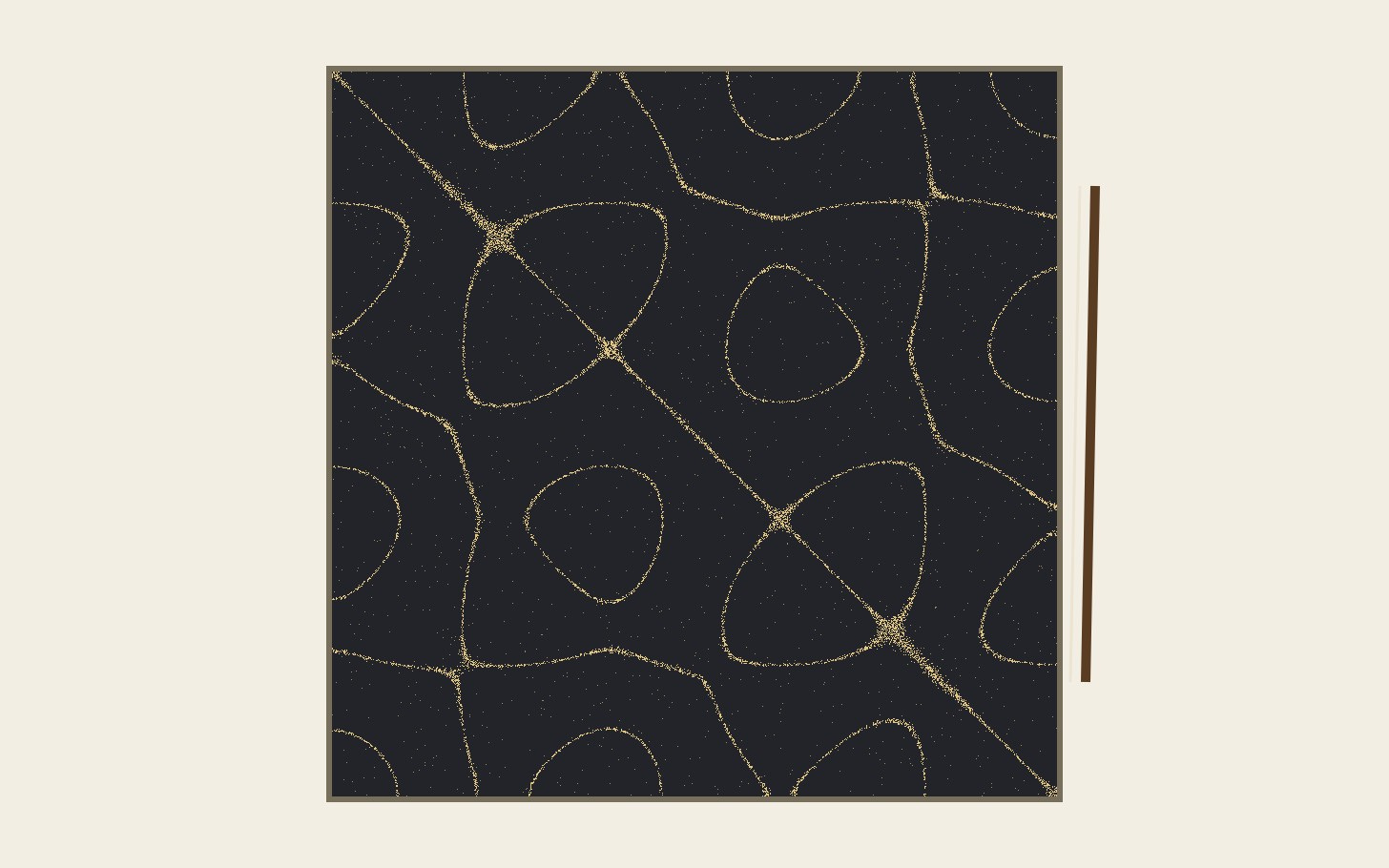
Around 1808, a German physicist named Ernst Chladni came to Paris with a striking demonstration. He sprinkled sand on a thin metal plate and drew a violin bow along its edge. As the plate vibrated, the sand danced away from the moving regions and settled along the still lines, forming intricate, symmetrical patterns. Different notes produced different figures.
The patterns were beautiful, and nobody could explain them mathematically. Napoleon was intrigued, and the Paris Academy of Sciences announced a prize for a mathematical theory of the vibrations of elastic surfaces that agreed with experiment. Many of the leading mathematicians of France judged the problem too difficult, or thought the mathematics of their day was not up to it.
Germain was the only person to submit an entry in the first round. It was rejected; her reasoning contained errors, which was not surprising for someone who had never received formal training in the calculus of variations. The deadline was extended. She tried again and received an honorable mention. She tried a third time. In 1816, at the age of 39, she won.
She was the first woman to win a prize from the Paris Academy of Sciences. She did not attend the ceremony; women were not welcome at its sessions unless they were the wives of members. When the Academy did not publish her winning memoir, she paid to publish it herself, in 1821.
What She Got Right, and What Others Fixed
Germain’s theory was not complete. Some of her assumptions, particularly about the conditions at the edges of a plate, were later shown to be wrong. Gustav Kirchhoff corrected them in 1850, and the classical theory of plate bending that engineers learn today owes as much to him and to later mathematicians as it does to her.
But she asked the right question, framed it in mathematical terms, and pushed it far enough that others could finish it. That matters more than it sounds. Plate theory is how engineers analyze bridge decks and floor slabs, ship hulls and aircraft skins, steel gusset plates and concrete walls. Every time a structural engineer checks how a flat element bends under load, they are working in a field she helped open.
She asked the right question, and pushed it far enough that others could finish the answer.
She also left a lasting mark on pure mathematics. Her work on Fermat’s Last Theorem was among the most important progress on the problem in the early nineteenth century. Mathematicians still study “Sophie Germain primes”: prime numbers p for which 2p + 1 is also prime.
An Ending, and a Late Correction
Germain never married. She developed breast cancer and died in Paris in 1831, at 55. Gauss had persuaded the University of Göttingen to award her an honorary degree, but she died before it could be conferred. Her death certificate, as it is often told, recorded her not as a mathematician but as a rentière, a woman of independent means.
When the Eiffel Tower opened in 1889, she had been dead for nearly sixty years, and her name was not among the 72. In 1913, an American writer pointed out the omission and suggested the obvious reason: she was a woman.
The correction has taken a long time. In January 2026, the city of Paris unveiled a list of 72 women scientists whose names are to be engraved in gold on the tower’s first level, alongside the original men. Sophie Germain is among them. The work is expected to be completed by 2027.
Why an Engineer Should Care
It is easy to read Germain’s story as a story about exclusion, and it is that. But it is also a story about how engineering knowledge actually gets built. Her first attempt failed. Her second was only partly right. Her final theory had flaws that someone else fixed decades later. None of that made her contribution smaller. It made it normal. Almost every useful theory in engineering arrived the same way: incomplete, contested, and improved by many hands.
The difference is that most people who make that kind of contribution are allowed into the room where the work is discussed. Germain was not. She had to borrow a man’s name to get the lecture notes, and she could not attend the ceremony for her own prize.
The next time you calculate the deflection of a slab or the stress in a plate, it is worth remembering that one of the people behind the theory had to study it by hidden candlelight. Her name is finally going up on the tower. It belonged there all along.
❦