


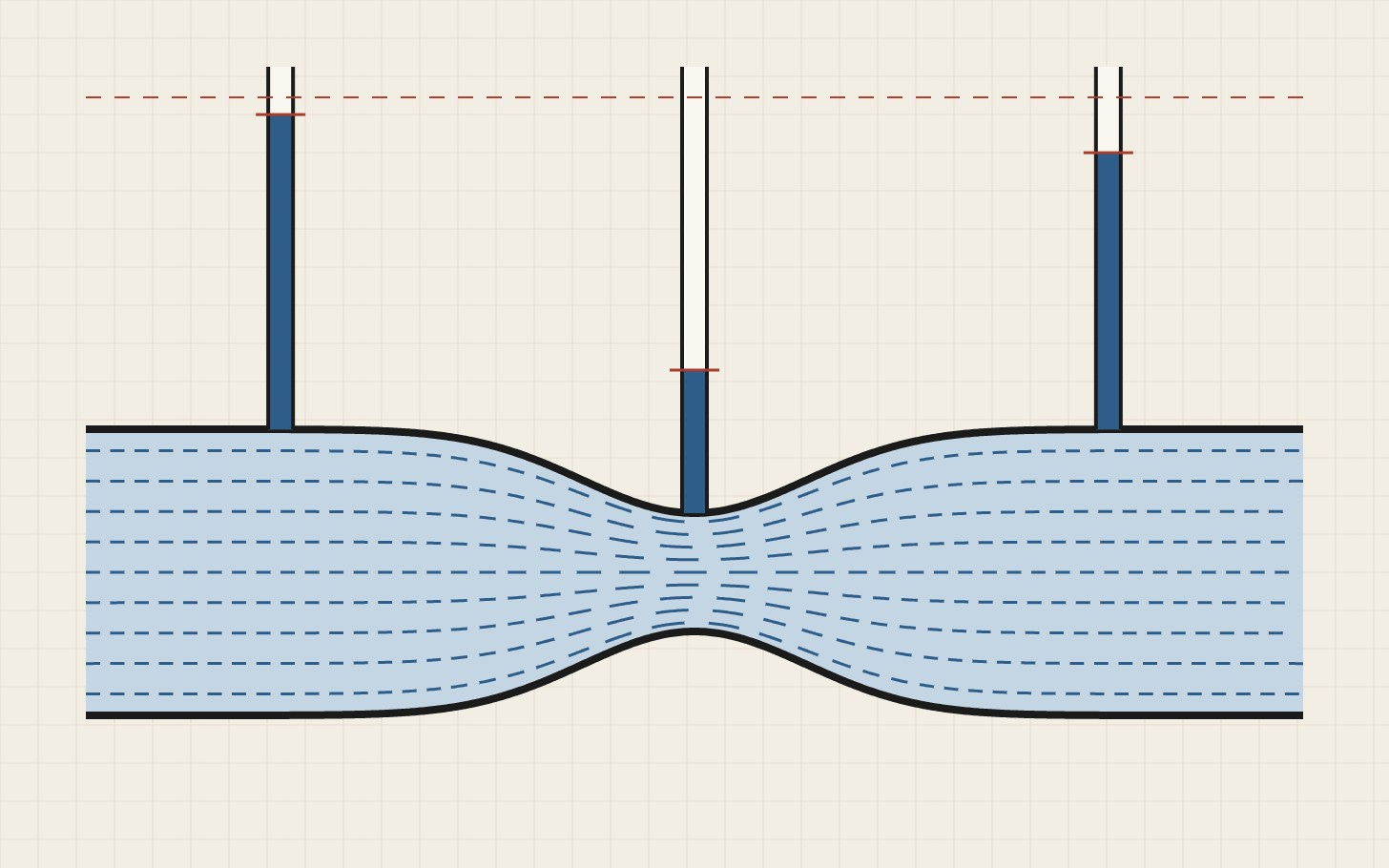
Every civil engineering student meets him in a fluids course, usually in the second or third week. The instructor sketches a pipe that narrows in the middle, draws a few arrows, and writes a line that looks almost too tidy to be true: pressure, plus the energy of motion, plus the energy of height, stays constant along a streamline. Where the fluid speeds up, its pressure falls. Where it slows, the pressure returns.
It is called Bernoulli’s principle, and it is everywhere. It sizes the culverts under our highways and the spillways on our dams. It explains why a Venturi meter can measure flow without a single moving part, and how a Pitot tube on an aircraft’s nose reads airspeed. Water engineers lean on it so often that they stop noticing it, the way a carpenter stops noticing a level.
Few of them know that the man who published it was thrown out of his family home for doing well, or that his father later tried to claim the idea as his own.
A Family Business in Mathematics
The Bernoullis were a family of refugees before they were a family of mathematicians. Protestant merchants from Antwerp, they had fled religious persecution in the Spanish Netherlands and eventually settled in Basel, Switzerland, where they traded spices and kept their heads down.
Then, in a single generation, the family began producing mathematicians the way other families produce lawyers. Jacob Bernoulli helped found probability theory and discovered the constant we now call e. His younger brother Johann became one of the first great masters of calculus, a teacher to Leonhard Euler and, quietly, the source of much of the first calculus textbook ever printed. Over three generations the family produced eight mathematicians of note.
They were brilliant. They were also, by most accounts, impossible. Jacob and Johann spent years attacking each other in print, each insisting the other had stolen or bungled a solution. It was a family in which talent was abundant and generosity was not.
Johann’s father had tried to force him into business. Johann then did exactly the same thing to his own son.
A Son Steered Away
Daniel Bernoulli was born in 1700 in Groningen, in the Netherlands, where his father held the chair of mathematics. From early on he showed the family gift. Johann’s response was to try to keep him away from it.
Mathematics, Johann told him, did not pay. Daniel should become a merchant. The irony is hard to miss: Johann’s own father had once tried to push him into commerce, and Johann had fought it bitterly. Now he did the same thing to his son. Daniel resisted, and the two settled on a compromise that suited neither. Daniel would study medicine, and his father would teach him mathematics on the side.
It turned out to be a useful detour. Daniel’s medical thesis was on respiration, and his interest in how blood moves through the body fed directly into his later thinking about how fluids move through pipes. In 1725 he accepted a post at the new Academy of Sciences in St. Petersburg. He was lonely there, and wrote home saying so. His father’s solution was to send one of his best students to keep him company: a young Swiss named Leonhard Euler. The two became close friends and, for a few years, the most productive pair of mathematicians in Europe.
The Prize That Broke a Family
In 1734 the Paris Academy of Sciences, the most prestigious scientific body in Europe, announced the winners of its annual prize. That year the question concerned the orbits of the planets. The prize was split between two entries. One came from Johann Bernoulli. The other came from his son.
Most fathers would have been proud. Johann was furious. He could not tolerate being ranked as his son’s equal, and he banned Daniel from the family house. Daniel would go on to win the Paris prize many more times over his career. His father never forgave him for the first one.
Hydrodynamica, and Hydraulica
For years Daniel had been working on a book about how fluids move: water flowing through pipes, the force of a jet, the pressure on the walls of a vessel, the efficiency of pumps and machines for raising water. He finished the manuscript before leaving St. Petersburg, and after long delays it was printed in 1738 under the title Hydrodynamica. It was the first book to treat flowing fluids as a unified subject, and it is the reason the field still carries that name. In one chapter, almost in passing, Daniel modeled a gas as countless tiny particles colliding with the walls of their container, an idea that would become the kinetic theory of gases a century later.
Then Johann did something that still startles historians. He wrote his own book on the same subject, called it Hydraulica, and put a date of 1732 on it. The book drew heavily on his son’s work. The false date was meant to suggest the reverse: that the father had written it first, and the son had borrowed.
The deception did not hold. Colleagues recognized what had happened, and Johann’s reputation suffered for it. But the damage to the relationship was permanent. Daniel tried to reconcile. His father refused, and carried the grudge until his death in 1748.
The father had the talent to write his own masterpiece. What he lacked was the ability to let his son have one.
What the Equation Actually Says
Strip away the family drama and the idea is beautifully simple. A moving fluid carries energy in three forms: the pressure it exerts, the energy of its motion, and the energy it has because of its height. Along a smooth path, and if friction is ignored, the total stays the same. Squeeze the flow through a narrow section and it must speed up to get the same volume through. Because more of its energy is now in motion, less is left as pressure.
It is worth adding an honest footnote. Bernoulli’s principle is often used to explain why airplanes fly, usually with a story about air “needing” to travel faster over the curved top of a wing. That story is incomplete at best. The principle is real, and pressure differences do produce lift, but the full explanation involves how the wing turns the air downward as well. Even the most famous equations get misused when we want a simple story.
In engineering practice, the equation is a starting point. Real pipes have friction, real channels have turbulence, and real pumps lose energy. Engineers add correction terms for all of it. But the skeleton of almost every hydraulic calculation, from a storm drain to a hydroelectric penstock, is still the balance Daniel Bernoulli wrote down in the 1730s.
A Life Beyond the Quarrel
Daniel lived to 82. He returned to Basel, where he held chairs in anatomy, botany, physiology and finally physics, which is roughly the career of three ordinary scholars folded into one. He used mortality data to argue, with early statistics, that inoculation against smallpox would save lives, at a time when the practice was still controversial. He worked on vibrating strings, on probability, and on the problem of how people value risk, an idea economists still cite today.
He never married and had no children. Like Hooke and Newton, he left his inheritance in equations rather than in descendants.
Why an Engineer Should Care
There is an old temptation in engineering education to treat great names as statues: Bernoulli’s equation, Euler’s buckling load, as if the ideas arrived fully formed from people who had nothing else going on. The Bernoullis are a useful corrective. These were people with families and grudges, ambitions and insecurities. One of the most important books in the history of fluid mechanics was written by a man whose own father tried to discredit it.
There is a quieter lesson too. Johann Bernoulli was a great mathematician, and nothing in his own record needed his son’s work to prop it up. His mistake was treating knowledge as a contest in which one person’s success meant another’s loss. Daniel’s book did not diminish his father. It extended him. That is how knowledge is supposed to work.
The next time you write the Bernoulli equation on a page, remember that it carries a family’s name, and a family’s wound. Behind the tidy line of symbols is a young man who was told mathematics would not pay, did it anyway, and gave the world a principle that still moves its water.
❦