


Every engineer memorizes them long before learning who wrote them. On the first day of an introductory physics course, an instructor turns to the board and writes F = ma. A little later, almost as an afterthought, comes a second line: F = −kx. Students copy them down, solve their problem sets, sit their examinations, and move on.
Years later, those same students are laying out bridges, tuning the suspension of a car, or modeling how a skyscraper sways in a gale — still leaning on two short expressions, and rarely sparing a thought for the men behind them. Yet behind the symbols stand two Englishmen who spent much of their lives locked in open hostility, and whose quarrel helped shape which discoveries the world got to keep.
Two Men, One Century
Robert Hooke was born in 1635 on the Isle of Wight. Isaac Newton followed seven years later, in 1642, in a Lincolnshire farmhouse. They came of age during what historians now call the Scientific Revolution — a stretch of decades when old certainties buckled, telescopes disclosed new worlds, microscopes revealed invisible ones, and mathematics was quietly becoming the language of nature.
Hooke and Newton did not merely witness that revolution; they stood near its center. And though each is remembered today for a single equation, both ranged across nearly every science of their age.
The Forgotten Genius
Ask an engineering student what Robert Hooke discovered, and the answer comes back in three words: Hooke’s Law. It is a thin epitaph for so restless a mind.
Hooke improved the microscope and the telescope. He helped survey and rebuild London after the Great Fire of 1666. He designed instruments, puzzled over fossils, and made observations in astronomy. Peering at a sliver of cork through one of his own lenses, he saw a honeycomb of tiny compartments and gave them a name that has never left biology: cells.
His book stunned a continent. Then history filed him under a single law.
His 1665 volume, Micrographia, astonished Europe with its fold-out engravings of fleas and crystals and the compound eye of a fly. For many readers it was the first glimpse of a hidden microscopic world. Hooke’s curiosity seemed to have no floor. And yet posterity has narrowed him to one equation about springs.
The Architect of Mechanics
Newton needs less rescuing. He devised the calculus independently of Leibniz, formulated three laws of motion, explained the orbits of the planets, and bound the heavens and the earth together under a single law of universal gravitation.
His 1687 masterwork, the Philosophiæ Naturalis Principia Mathematica, is routinely called one of the most important books ever written. Few thinkers have reshaped humanity’s picture of nature so completely, or left successors so ready to say, in Newton’s own borrowed phrase, that they had seen further only by standing on the shoulders of giants.
An idea, Newton insisted, is not enough. Science also demands proof.
THE HEART OF THE QUARREL OVER GRAVITY
A Feud Conducted in Letters
It is tempting to imagine Hooke and Newton in separate eras. They were not. Both belonged to the Royal Society; both attended its meetings, traded letters, and pored over each other’s work. What began as collegial scrutiny curdled, over the years, into something closer to enmity.
The first real rupture came in 1672, when Newton presented his experiments on light and color — the claim that white light is a mixture of the spectrum’s hues. Hooke, who had his own theory of light, objected sharply. Scientific disagreement is ordinary and healthy. Personal disagreement is more corrosive. Newton took the criticism to heart, and for years afterward grew reluctant to publish at all. It is sobering to wonder how many ideas stayed locked in his notebooks because of it.
Then Came Gravity
The bitterest dispute concerned gravity itself. Hooke believed he deserved credit for suggesting that the planets are drawn toward the Sun by a force that weakens with distance. Newton allowed that Hooke had, indeed, floated the notion.
But Newton drew a hard line between a suggestion and a demonstration. Hooke had a hunch; Newton supplied the mathematics. Using geometry and his new calculus, he proved that the very law pulling an apple to the ground could also hold the Moon in its orbit and swing the planets around the Sun. That proof changed science forever.
Hooke felt robbed of his due. Newton felt Hooke was claiming ownership of mathematics he had never done. Tellingly, it was in a 1675 letter to Hooke that Newton wrote his most famous sentence — about seeing further by standing on giants’ shoulders — a line some historians read less as humility than as a quiet barb at his rival. The argument never truly ended.
The Irony of It All
Here is the twist the two men never lived to enjoy. They spent years at each other’s throats. Yet today every engineering student, unknowingly, brings them back together at the very first opportunity.
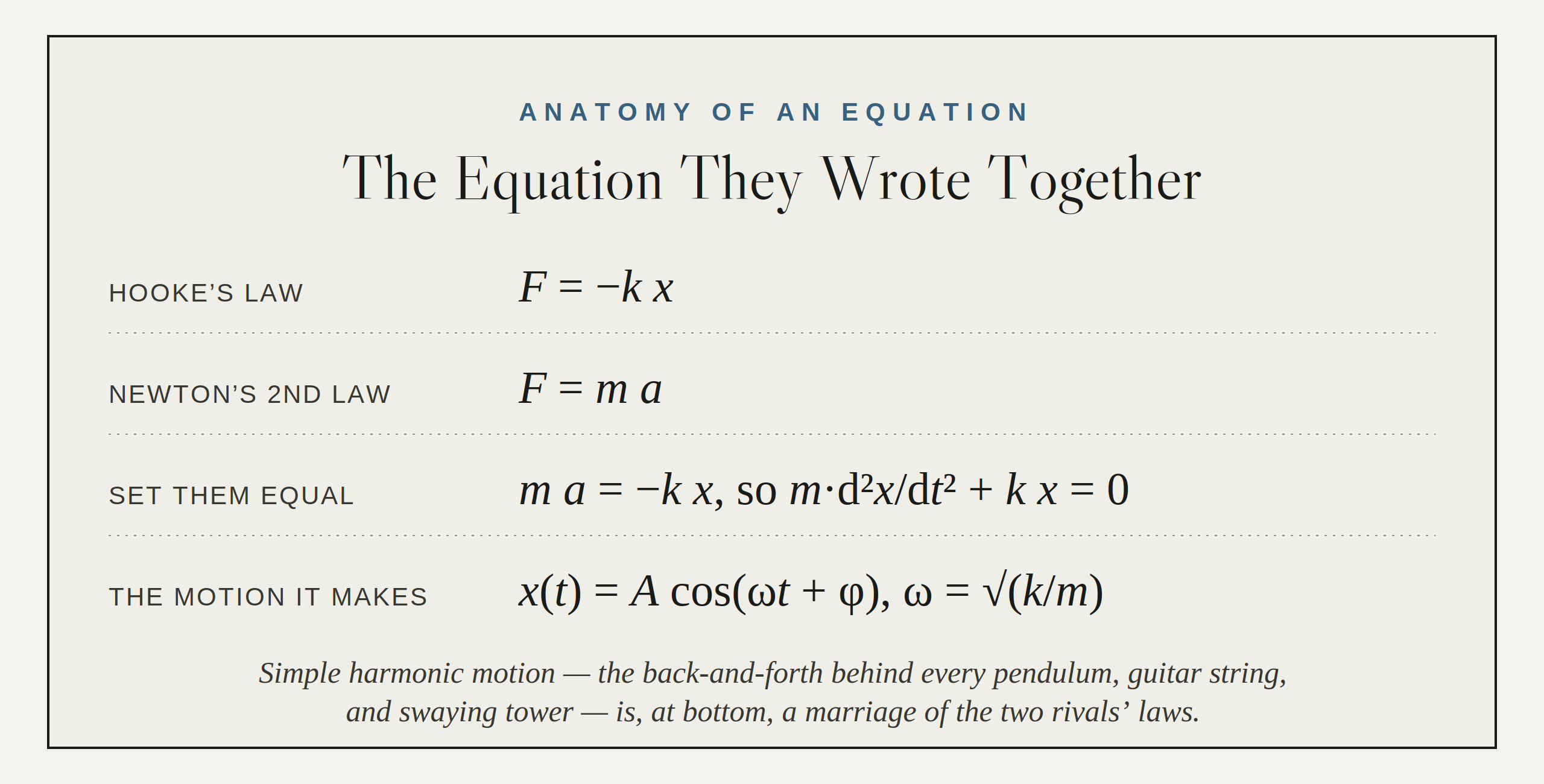
Hooke’s law tells us how an elastic material pushes back when it is stretched or squeezed. Newton’s second law tells us how a force sets mass into motion. Apart, each is powerful. Set one equal to the other — the spring’s restoring pull on one side, the resulting acceleration on the other — and out falls the equation of simple harmonic motion, the seed of vibration analysis, structural dynamics, and much of modern mechanical engineering. The rivals who could not agree in life now collaborate on every blackboard.
Beyond Springs
At a glance, Hooke’s law looks like a fact about coil springs. Its reach is far wider. Wherever engineers analyze elastic deformation — a steel beam bending, reinforced concrete before it cracks, a machine part under load, a vibration isolator absorbing a jolt — Hooke’s insight is quietly at work.
Newton’s second law travels just as far from the orchard. It governs cars and aircraft, satellites and spacecraft, bridges shaken by earthquakes, towers pushed by wind, the joints of a walking robot, even the mechanics of the human body. These two equations are among the first things an engineer learns precisely because they remain among the most useful things an engineer will ever know.
The Missing Face
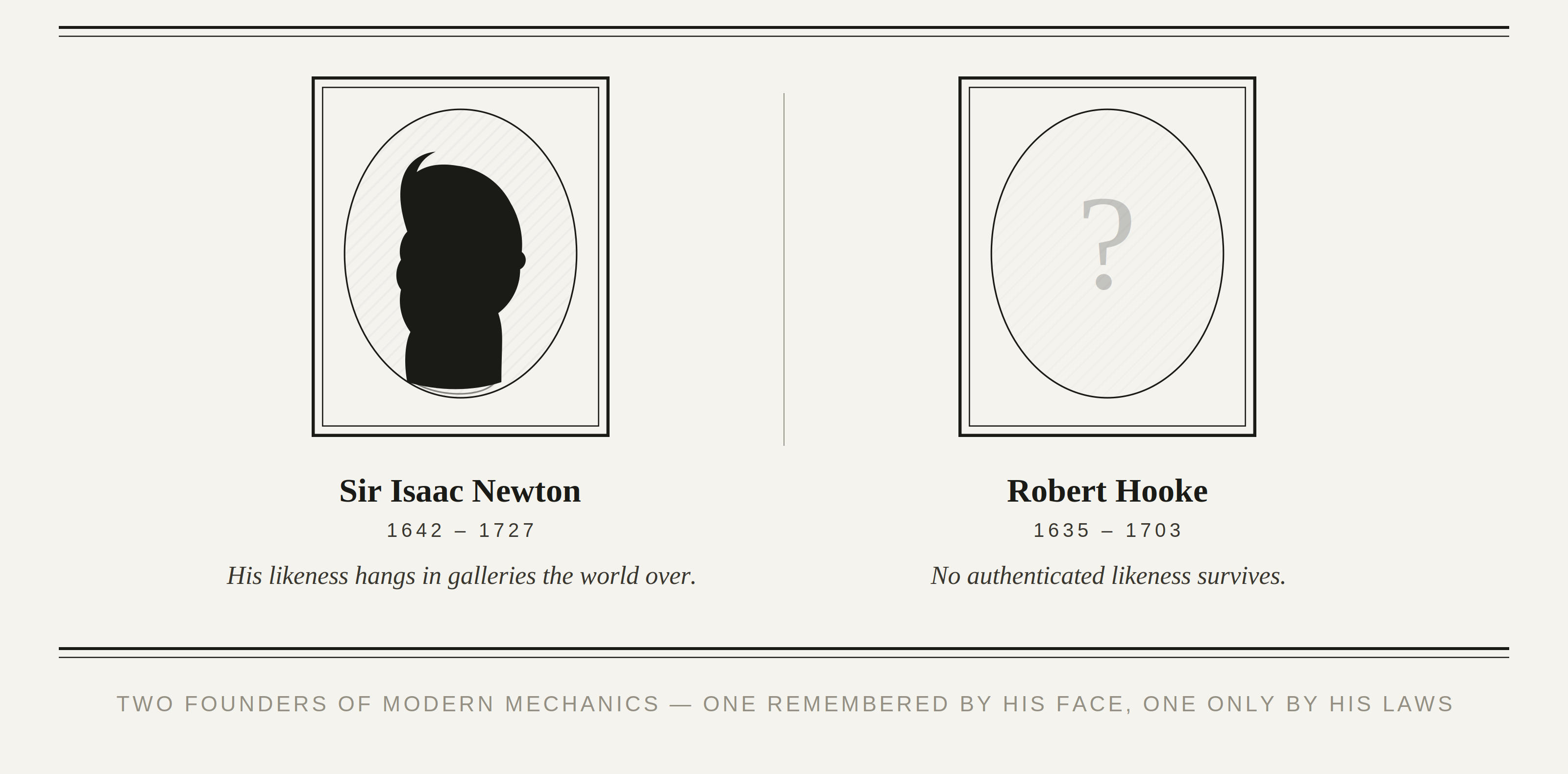
One small mystery clings to Robert Hooke. Newton’s face is familiar to millions; Hooke’s is unknown. No authenticated portrait of him is known to survive.
For centuries a rumor persisted that Newton, in his years of power at the Royal Society, destroyed Hooke’s likeness out of spite. Modern historians find little to support the story; the portrait was more likely lost to ordinary neglect than to malice. A painting once hopefully identified as Hooke turned out, on closer study, to depict another natural philosopher entirely. And so one of the founders of modern science looks out at us from behind a blank frame — present in every laboratory, absent from every wall.
A Legacy Without Heirs
Neither man married; neither left children. In the ordinary sense, both family lines simply stopped. And yet each achieved something exceedingly rare. Three centuries after their deaths, millions of students still learn their ideas by heart.
Their true descendants are intellectual: every scientist, engineer, and inventor who has built on their foundations. Few inheritances outlast an equation that keeps on explaining the world.
Why an Engineer Should Care
Engineering is often taught as a catalogue of formulas to be trusted and applied. History offers a useful correction: every formula began as a question. Someone looked at the world a little differently. Someone doubted the accepted answer. Someone failed, and failed again, and kept going in the face of criticism.
Hooke and Newton were not saints. They competed, they sulked, they claimed and counter-claimed. And still, between them, they laid the foundations of modern mechanics. Perhaps that is the quiet lesson underneath the equations: progress is rarely the gift of a lone genius. It is built, argument by argument, by people who inspire and provoke and occasionally infuriate one another. That is how knowledge grows.
The next time you meet F = ma or F = −kx, pause a moment. These are more than equations. They are reminders that behind every discovery is a human story — curiosity and stubbornness, rivalry and reconciliation, and the long, relentless pursuit of understanding. Perhaps that is the truest lesson of engineering itself.
❦